


 Featured
Join the global bottle deposit program
Fuelled by the world’s most progressive people.
How a technology built for financial transactions became infrastructure for environmental accountability, and what it actually does inside Plastic Bank’s collection system.
Disclosure: This article is published by Plastic Bank, which uses blockchain as a core part of its operations. Our methodology and sources are at the bottom.
Blockchain has a reputation problem in sustainability. The word conjures images of Bitcoin mining rigs consuming the energy output of small countries. But the blockchain technology used in environmental applications is a different species entirely. It is permissioned, low-energy, and purpose-built for one job: creating records that no single party can alter after the fact.
That job turns out to be exactly what sustainability claims need. When a brand says “this product contains recycled ocean plastic,” someone has to prove it. When a collector in Indonesia says they deposited 12 kilograms of PET at a branch on Tuesday morning, someone has to verify it. Blockchain does not collect the plastic. It creates the receipt that makes the claim auditable.
1. What blockchain actually does in sustainability work
A blockchain is a distributed ledger: a record of transactions shared across multiple computers, where each entry is cryptographically linked to the one before it. Once a transaction is recorded, it cannot be changed without changing every subsequent record, which makes tampering detectable.
In sustainability, this solves a specific trust problem. Environmental claims (“we recycled X tonnes,” “this product is carbon-neutral,” “our supply chain is deforestation-free”) depend on data that passes through many hands. Each handoff is a point where records can be lost, altered, or fabricated. A blockchain creates a shared, tamper-evident version of that data that all parties can see and none can unilaterally edit.
The applications where this matters most are supply chain traceability (tracking a material from origin to product), carbon and plastic credit verification (proving that an offset corresponds to a real action), and ESG reporting (providing auditable data for regulatory compliance). Blockchain does not make sustainability happen. It makes sustainability claims harder to fake.
2. How Plastic Bank uses blockchain
Every plastic deposit at a Plastic Bank collection branch creates a transaction on Hyperledger Fabric, a permissioned blockchain standard created by IBM and Digital Asset and hosted by the Linux Foundation. The system runs on IBM LinuxONE servers on IBM Cloud, built and managed by IBM Business Partner Cognition Foundry.[1][2]
Here is what a single transaction records: collector ID, GPS location of the branch, distance from the nearest shoreline, weight of the deposit, material type (PET, PP, flexible film, mixed), timestamp, and the payment issued (cash amount plus digital token bonuses). As the material moves through the supply chain, the record extends: processing partner, recycling output, and the brand that ultimately purchases the Plastic Credit. The full chain of custody, from a collector’s hands to a brand’s packaging, exists as a single traceable record.[3]
For the 63,000+ collectors across five countries (Philippines, Indonesia, Brazil, Egypt, and Thailand), the same platform serves as a digital wallet and benefits access point. Collectors store earnings, receive token bonuses, and access health insurance, grocery vouchers, school supplies, and interest-free loans through the app. For many, it is their first experience with any form of digital banking.[4]
For brands purchasing Plastic Credits (current partners include SC Johnson, Coca-Cola Philippines, and Acer), the blockchain data is the evidence behind the claim. A brand can trace a specific Plastic Credit back to a specific collection event at a specific branch on a specific date. That level of granularity is what distinguishes a Plastic Credit from a generic recycling offset.[5]
tatements. Instead of simply saying they support plastic recovery, businesses can point to more specific impact records, such as the amount of plastic collected or the communities supported through the collection ecosystem.
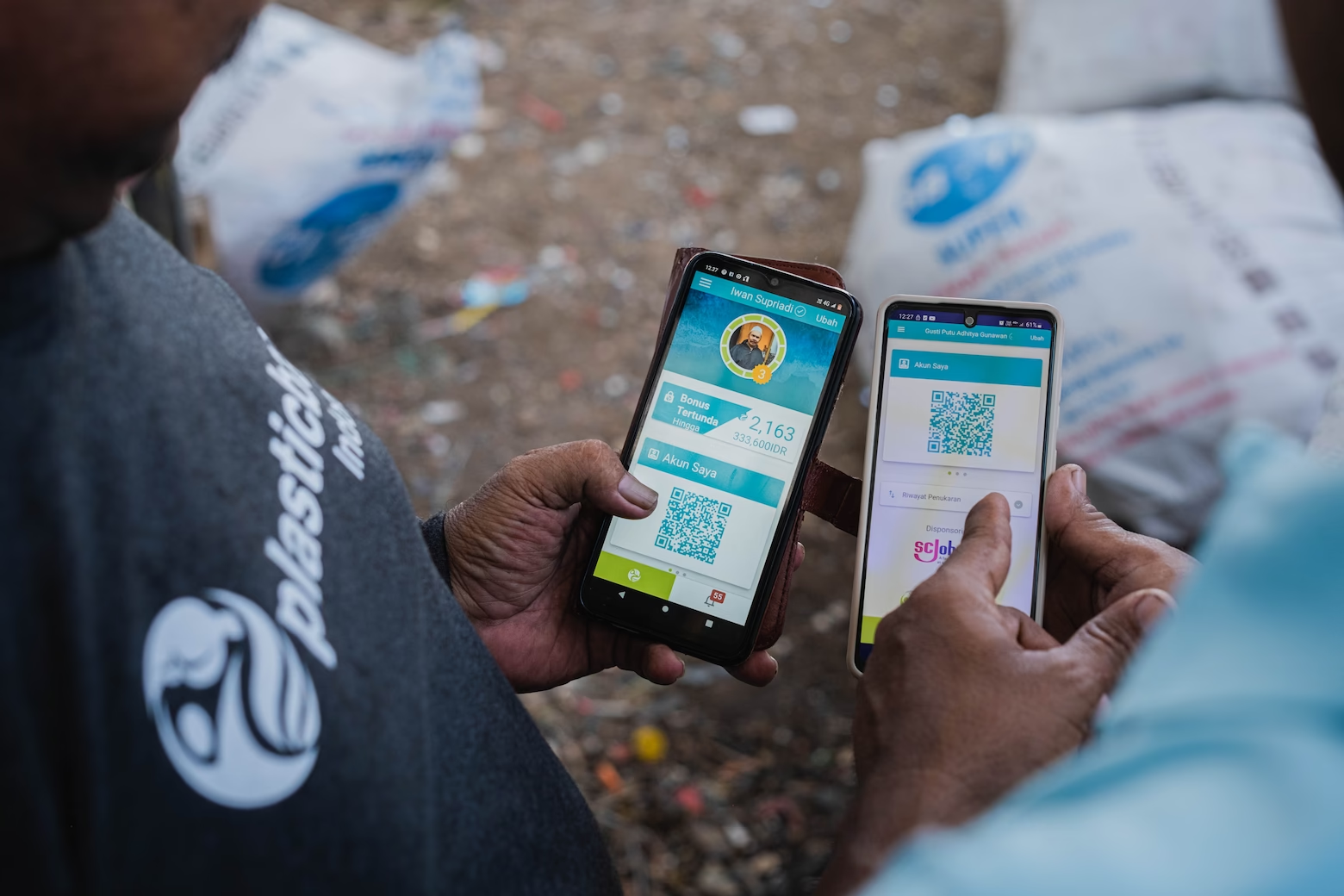
How Plastic Bank uses Blockchain
3. What this means for brands and compliance
Regulatory pressure on environmental claims is increasing. The EU Green Claims Directive (expected to come into force by 2026) will require companies to substantiate environmental marketing claims with verifiable evidence. Greenwashing penalties are rising. Investors and procurement teams are asking for auditable sustainability data, not just commitments.
Plastic Bank’s blockchain platform addresses this directly. A brand using Plastic Credits can provide regulators, auditors, and investors with per-transaction records showing exactly when, where, and how much plastic was collected, and where it went. The data is not generated by the brand itself. It is generated by the platform at the point of collection and immutably recorded.[1]
This matters for four specific compliance scenarios: Extended Producer Responsibility (EPR) reporting, where brands must demonstrate they are managing the waste impact of their packaging; ESG disclosures under frameworks like GRI and SASB; voluntary sustainability certifications that require supply chain documentation; and marketing claims about recycled content or plastic neutrality where regulators may demand evidence.
4. Is blockchain environmentally sustainable?
This is the question most people ask first, and the answer depends entirely on which type of blockchain you are talking about.
Bitcoin and Ethereum (before its 2022 merge) use proof-of-work consensus, which requires massive computational power and energy. Bitcoin’s annual energy consumption is comparable to that of some mid-sized countries. These are public, permissionless blockchains designed so that anyone can participate, and the energy cost is the price of that openness.
Plastic Bank does not use proof-of-work. Its platform runs on Hyperledger Fabric, a permissioned blockchain. In a permissioned system, only authorized nodes process transactions. There is no mining, no competitive computation, and no energy arms race. The energy consumption of a Hyperledger Fabric network is a fraction of a proof-of-work chain, comparable to running a conventional enterprise database.[2]
The IBM LinuxONE servers that host Plastic Bank’s platform are themselves designed for energy efficiency. IBM has positioned LinuxONE as its most energy-efficient server architecture, consolidating workloads that would otherwise require hundreds of distributed servers.[1]
The short version: the blockchain Plastic Bank uses consumes negligible energy compared to the environmental value of the 190 million kilograms of plastic its platform has helped track and verify.
5. What blockchain cannot do
Blockchain verifies records. It does not verify reality. If someone enters false data at the point of collection (wrong weight, wrong material type), the blockchain will faithfully record that false data and make it immutable. The technology solves the problem of records being tampered with after entry. It does not solve the problem of bad data being entered in the first place.
Plastic Bank addresses this through operational controls: branch operators inspect and weigh material, collectors are identified through the app, GPS confirms the branch location, and processing partners provide downstream verification. The blockchain sits on top of these controls. It is the audit layer, not the quality control layer.[3]
This distinction matters because blockchain is sometimes marketed as a silver bullet for trust. It is not. It is one layer in a system that also requires physical inspection, third-party auditing, and operational integrity. Blockchain makes the records harder to fake after the fact. The rest of the system makes the records accurate in the first place.
6. Other sustainability applications for blockchain
Plastic Bank is one example. Other organizations use similar technology for different environmental problems. Carbon credit registries (Verra, Gold Standard) are exploring or implementing blockchain-based tracking to prevent double-counting of offsets. Deforestation monitoring platforms use satellite data combined with blockchain to create tamper-evident land-use records. The Diamond industry (De Beers’ Tracr platform) uses blockchain to track stones from mine to retail, addressing both ethical sourcing and environmental concerns.
In each case, the pattern is the same: a multi-party supply chain where trust depends on records that no single party controls. Blockchain provides the shared, immutable record layer. The environmental work happens off-chain.
Frequently asked questions
Can blockchain help with plastic credit fraud?
Yes. Plastic credit fraud typically involves double-counting (the same collection event sold to multiple buyers) or fabrication (credits issued for plastic that was never collected). A blockchain ledger makes double-counting structurally impossible because each collection event has a unique, time-stamped record that can only be assigned to one credit. Fabrication is harder to prevent through technology alone, which is why Plastic Bank combines blockchain with physical inspection, GPS verification, and downstream processing checks.[3]
How much does Plastic Bank’s blockchain cost to run?
Plastic Bank has not disclosed the specific operational cost of its Hyperledger Fabric infrastructure. However, permissioned blockchain platforms on enterprise cloud infrastructure (IBM Cloud, in this case) are generally priced as conventional SaaS workloads, not as energy-intensive mining operations. The cost is a line item in IT operations, not a significant environmental expenditure.
Is Hyperledger Fabric the same as Ethereum or Bitcoin?
No. Hyperledger Fabric is a permissioned, enterprise-grade blockchain. Only authorized participants can read and write transactions. There is no cryptocurrency, no mining, and no public token trading. It was created by IBM and Digital Asset and is hosted by the Linux Foundation. Bitcoin and Ethereum (pre-merge) are public, permissionless blockchains designed for open participation, with energy-intensive consensus mechanisms. They serve different purposes.[2]
Do collectors need to understand blockchain to use the app?
No. The blockchain runs in the background. Collectors interact with the PlasticBank app the same way they would interact with any mobile payment or banking app. They see their balance, their transaction history, and their available benefits. The blockchain is the infrastructure that makes those records secure and verifiable, but the user experience is a standard mobile interface, not a crypto wallet.
Can other organizations use the same blockchain approach?
Yes. Hyperledger Fabric is open source and available to any organization. The challenge is not the blockchain itself but the operational system around it: the collection branches, the payment infrastructure, the processing partnerships, and the brand relationships that give the data commercial value. Blockchain is the verification layer. Building what it verifies is the hard part.
Sources and footnotes
All sources accessed and verified as of April 2026.
[1] IBM Case Study, Plastic Bank – IBM LinuxONE infrastructure, IBM Cloud, Cognition Foundry, blockchain platform, IBM Garage co-creation process, supply chain traceability, real-time data visualization. https://www.ibm.com/case-studies/plastic-bank-systems-linuxone
[2] Inverse, How IBM and Plastic Bank use blockchain – Hyperledger Fabric enterprise standard, IBM and Digital Asset, Linux Foundation hosting, LinuxONE servers, two-token system (USD-pegged tradable token + goods-exchange token), French Creole app. https://www.inverse.com/article/49158-how-ibm-and-plastic-bank-are-using-blockchain-to-boost-recycling-in-haiti
[3] Insureblocks, Deep Dive on Plastic Bank’s Blockchain – Collector registration, traceable supply chain, digital wallet rewards, GPS mapping, distance from shoreline, verification of real people and real plastic, full audit trail for clients. https://insureblocks.com/?p=13614
[4] Plastic Bank, Global Impact – 63,000+ collectors, 5 countries, 190M+ kg collected, Plastic Credits, partners (SC Johnson, Coca-Cola Philippines, Acer), health insurance, grocery support, school supplies, interest-free loans. https://plasticbank.com/global-impact/
[5] Plastic Bank, About Us – Social fintech, digital wallet, collector benefits, founding story, Plastic Credits model. https://plasticbank.com/about/
[6] IBM Blog, Want to reduce ocean pollution? – Hyperledger Fabric, IBM Blockchain Platform, LinuxONE servers on IBM Cloud, Design Thinking process with IBM Garage team, Shaun Frankson quote on blockchain as trust infrastructure. https://www.ibm.com/blog/want-to-reduce-ocean-pollution-blockchain-is-paving-the-way/
[7] Blockchain Technology News, Plastic Bank project – Hyperledger Fabric and IBM LinuxONE collaboration, Cognition Foundry development, David Katz quote on hope and dignity. https://blockchaintechnology-news.com/news/plastic-bank-blockchain-project-looking-clear-oceans/
Methodology: Technical details sourced from IBM case studies, Insureblocks podcast transcript, and published reporting. Plastic Bank figures sourced from plasticbank.com/global-impact/ as of April 2026. All source URLs verified at publication.